
Share this
by Expede on Dec 13, 2025, 11:56:24 AM
Microsoft 365 modernization is often framed as a migration exercise: move files from legacy repositories into SharePoint, connect email via Exchange Online, and enable Copilot. In practice, this approach delivers limited value and, in many cases, introduces new risk.
True modernization is not about where content lives — it is about what that content is, how it is structured, governed, and understood by both humans and AI.
Expede Nexus was designed specifically to address this gap.
The Hidden Problem with Legacy Content in Microsoft 365
Most organizations entering Microsoft 365 bring decades of accumulated content:
-
Network file shares with inconsistent folder structures
-
Email archives containing critical decisions and approvals
-
Attachments with duplicated, conflicting, or obsolete information
-
Documents lacking metadata, ownership, or retention logic
When this content is migrated “as-is,” Microsoft 365 becomes a modern interface sitting on top of legacy disorder.
The result:
-
Copilot produces vague or misleading answers
-
Search returns too many or too few results
-
Purview policies are difficult to apply consistently
-
Regulatory and legal risk increases rather than decreases
Modernization fails not because of the platform — but because the content is unprepared.
What Defines “Good Content” in a Copilot-Ready Enterprise
For Microsoft 365 — and particularly Copilot — content quality is everything. Good content has several defining characteristics:
1. Clear Structure
Documents should follow consistent logical patterns:
-
Sections, tables, and headings are machine-detectable
-
Data is not embedded solely in free text or scanned images
-
Attachments are contextually linked to their source email or record
Copilot cannot reason reliably over unstructured chaos.
2. Rich, Trustworthy Metadata
Metadata is how Microsoft 365 understands content intent:
-
Business domain
-
Document type
-
Sensitivity and classification
-
Ownership and authority
-
Temporal relevance
Without metadata, Copilot treats a draft email and a board-approved policy as equivalent sources.
3. Governance Alignment
Modern content must be compatible with:
-
Microsoft Purview retention and disposition
-
Sensitivity labels and access controls
-
Audit and legal discovery requirements
If governance is applied after migration, gaps are inevitable.
4. AI-Ready Semantics
Copilot does not “read” like a human. It relies on:
-
Consistent terminology
-
Domain-specific language
-
Explicit relationships between concepts
Content modernization must include semantic normalization — not just file movement.
The Limitations of Microsoft Graph in Content Modernization
Microsoft Graph is a powerful API — but it is often misunderstood.
Graph is excellent at:
-
Accessing files and messages
-
Applying labels and permissions
-
Executing bulk migrations
Graph is not designed to:
-
Understand document meaning
-
Resolve conflicting versions
-
Extract structured data from complex documents
-
Apply domain-specific intelligence
-
Normalize historical content at scale
Graph moves content efficiently — but it does not improve it.
Relying solely on Graph-based migration tools leads to:
-
Faster transfer of poor-quality content
-
Inconsistent metadata application
-
Limited Copilot accuracy
-
Increased downstream remediation cost
Modernization requires an intelligence layer before Graph is used.
Why Content Modernization Is Critical for Copilot Value
Copilot’s effectiveness is directly proportional to the quality of the content it can access.
Poorly modernized content results in:
-
Hallucinated summaries
-
Overly cautious or generic responses
-
Missed institutional knowledge
-
Incorrect compliance interpretations
Well-modernized content enables:
-
Precise, explainable answers
-
Reliable cross-document reasoning
-
Confident use in regulated environments
-
Executive-level trust in AI outputs
In short: Copilot amplifies your content maturity — it does not replace it.
How Expede Nexus Enables End-to-End Microsoft 365 Modernization
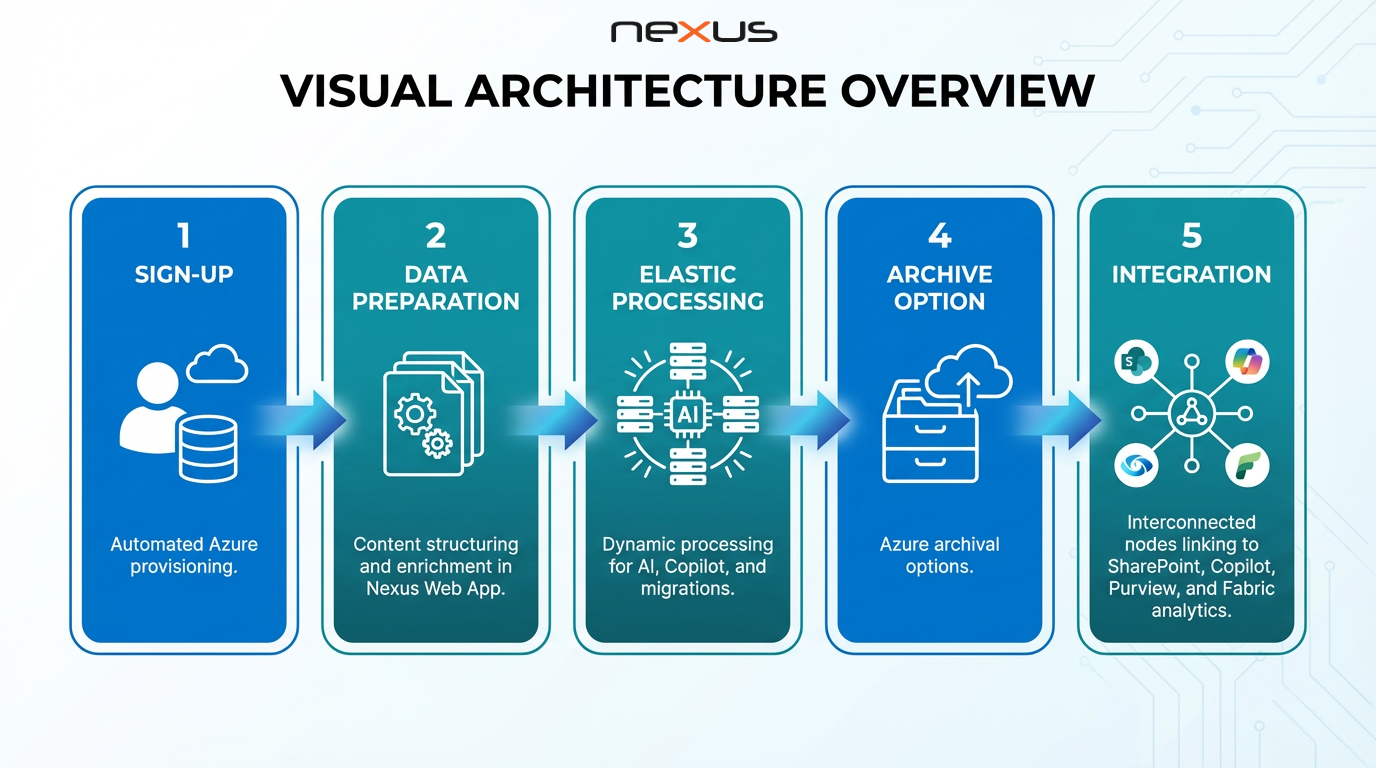
Expede Nexus delivers modernization as a complete lifecycle, not a single migration step.
By combining the Nexus Web App, Bridge Desktop, and Outlook Plug‑in, organizations can:
-
Ingest legacy files, emails, and attachments from any source
-
Clean and normalize content structure and formatting
-
Extract and enrich data using domain-specific intelligence
-
Apply consistent metadata and governance rules
-
Prepare content explicitly for Copilot and Purview
-
Deploy into SharePoint and Microsoft 365 using optimized, auditable scripts
Every file, email, and attachment is processed through a structured database — not simply copied between repositories.
This ensures:
-
Full auditability of every transformation
-
Clear lineage from source to SharePoint
-
Confidence in compliance and discovery
-
High-accuracy AI outcomes
Modernization Is a Knowledge Strategy, Not an IT Task
Organizations that succeed with Microsoft 365 treat modernization as a business capability:
-
Compliance teams gain enforceable governance
-
Analysts gain reliable, queryable information
-
Executives gain confidence in AI-driven insight
-
IT gains reduced technical and legal risk
Expede Nexus ensures that modernization delivers lasting enterprise value — not just a completed migration project.
Start Modernizing for Copilot, Compliance, and the Future
Microsoft 365 is the destination. Content modernization is the journey.
Expede Nexus makes that journey structured, auditable, and AI-ready — transforming legacy information into enterprise knowledge that works across Copilot, Purview, analytics, and governance.