
Born Into the Graph: The First Principle of the Post-Migration Economy
Born Into the Graph: The First Principle of the Post-Migration Economy
Why Post-Migration Value is Path-Dependent on Data Ingestion
The prevailing model of Microsoft 365 migration views the movement of files as a logistical event: moving data from Point A (legacy servers) to Point B (the cloud). This view is obsolete. In the era of Copilot and advanced AI, Microsoft 365 is no longer a storage repository; it is an intelligence substrate underpinned by the Microsoft Graph.
The principle of "Born Into the Graph." It asserts that the economic value of data is determined not by its presence in the cloud, but by how it arrives there. Data that is migrated without intentional structuring, metadata, and context creates "intelligence debt"—permanent blind spots that degrade AI performance, search relevance, and compliance posture. To thrive in the Post-Migration Economy, organizations must treat ingestion as the foundational moment where intelligence is either created or destroyed.
1. Foundational Doctrine: The Graph as Substrate
The Principle of Path Dependency
-
File Creation: The moment a piece of information is generated.
-
System of Record: Where that information is stored for retrieval.
-
Graph Visibility: The moment the Microsoft Graph becomes aware of the file and begins mapping its relationships.
Microsoft Graph only fully understands and manages content that resides in Microsoft 365 services (such as SharePoint Online and OneDrive for Business). Content stored on-premises or outside Microsoft 365 must be indexed or migrated before Graph can access it — and even then it is an indexed representation, not a first‑class Graph object.
The Core Law:
Microsoft Graph only learns from Graph-native objects. Intelligence compounds from the moment data enters the system. Late, polluted, or partial ingestion creates permanent blind spots that cannot be retroactively fixed by AI alone
2. The Post-Migration Economy
The industry has spent a decade optimizing for the speed of migration. The Post-Migration Economy demands we optimize for the quality of arrival. Migration is no longer a transfer of storage; it is the initialization of an intelligence engine.
Intelligence Compounding
In a Graph-native environment, value compounds over time. Every edit, share, meeting, and email associated with a document adds a layer of "signal" that Copilot uses to determine relevance.
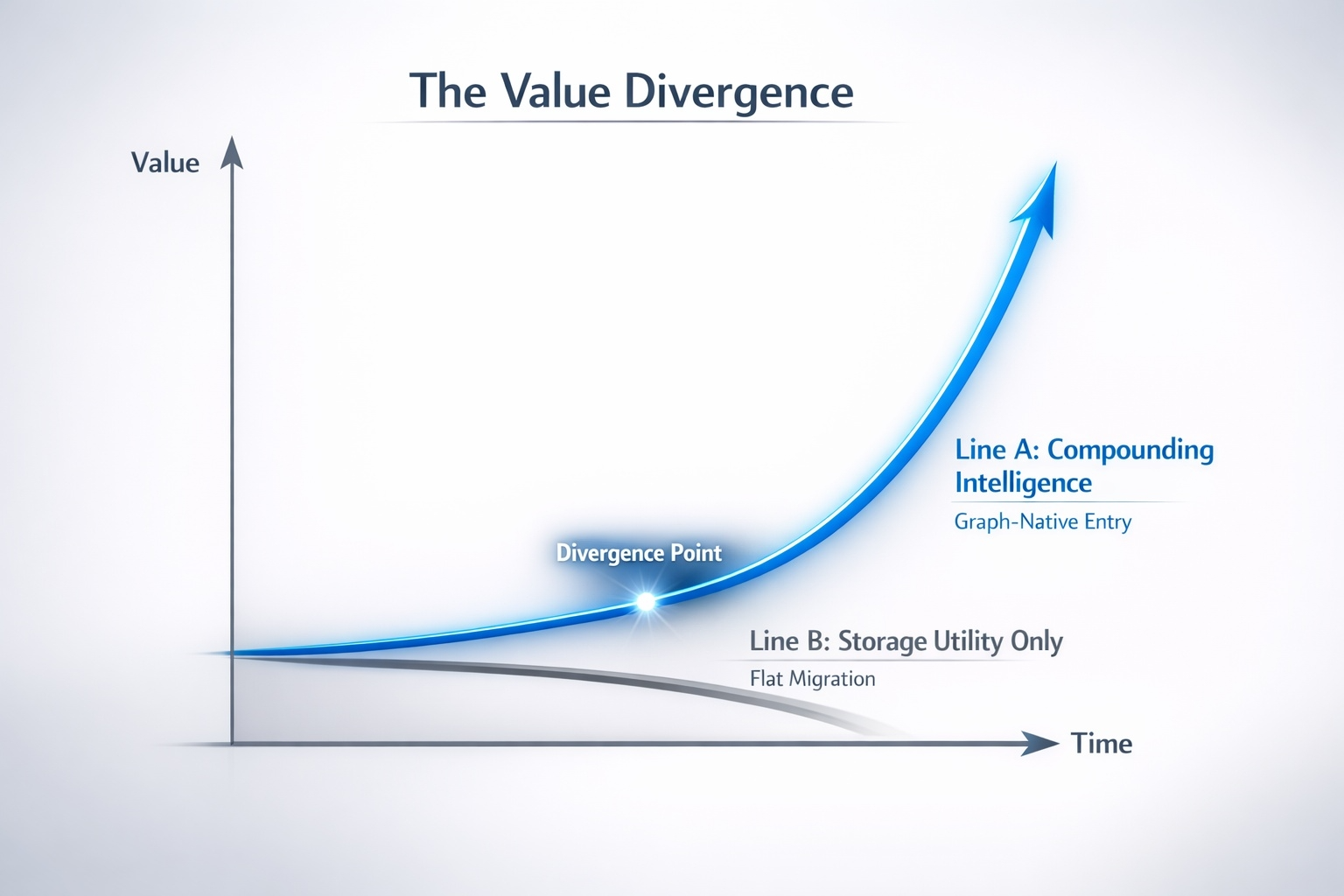
Data that is "Born Into the Graph" (or ingested with high-fidelity context) begins compounding value immediately. Data that is merely dumped into SharePoint acts as digital ballast—it occupies space and incurs cost, but generates no signal. This creates a divergence in organizational performance:
- Graph-Native Organizations experience increasing returns to scale on their data. AI gets smarter every day.
- Legacy-Migrated Organizations experience decreasing returns. As data volume grows, search noise increases and AI hallucinations become frequent.
Data Exhaust as Economic Signal
In the legacy world, metadata was a filing aid. In the Post-Migration Economy, metadata and "data exhaust" (who touched this, when, and why) are the primary economic signals. They are the fuel for Copilot. If this signal is stripped during migration, the economic potential of the asset is destroyed.
3. Failure Modes and Consequences
Ignoring the "Born Into the Graph" principle results in specific, predictable failure modes. These are often misdiagnosed as software flaws, but they are actually data foundation failures.
Copilot Hallucination as Graph Gaps
When executives ask, "Why does Copilot give me wrong answers?", the root cause is rarely the LLM (Large Language Model). The cause is Signal Pollution. If the Graph cannot distinguish between an outdated draft uploaded yesterday and a finalized policy created three years ago, it treats them as equally relevant. The AI hallucinates because the ground truth is fragmented.
Search Failure and Intelligence Debt
"We migrated everything, but can't find anything." This is the hallmark of Intelligence Debt. By rushing migration without pre-ingestion structuring, organizations incur a debt that must be paid in wasted employee time. Unlike technical debt, which sits in code, intelligence debt sits in the daily workflow of every knowledge worker.
Compliance Risk from Fragmented Lifecycles
If a file's lifecycle is not visible to the Graph from inception, retention labels and sensitivity policies cannot be applied reliably. The system sees a file created "today" (the date of migration), resetting the clock on retention schedules and exposing the organization to legal risk during discovery.
4. The Nexus Approach: Intentional Ingestion
Nexus exists to ensure data enters Microsoft 365 with intent, not as digital exhaust. The transition to the Post-Migration Economy requires a shift in methodology—from moving files to preserving context.
This approach relies on three operational pillars:
- Pre-Ingestion Structuring: Data must be organized according to how it will be used by AI, not how it was stored on a disk. This involves reshaping data hierarchies before they ever touch the tenant.
- Metadata Enrichment: Context must be injected into the file properties during the move. This artificially reconstructs the "signal" that the Graph needs to establish relevance.
- Context Preservation: The relationships between files (e.g., project folders, version histories) must be maintained so that the Graph perceives a coherent narrative rather than a pile of disconnected artifacts.
Nexus Positioning:
We do not simply move data. We prepare data to be "Born Into the Graph" so that it arrives as an asset rather than a liability.
“True Graph intelligence only arises when data is actually stored in Microsoft 365 services. Simply indexing on‑prem content does not make it a first‑class Graph object; it remains a proxy. Nexus ensures your data enters M365 in a way that Graph can deeply understand and continuously enrich.”
5. Key Takeaways and Strategic Implications
For CIOs and Data Leaders, the implications of this principle are clear:
-
Migration is the Point of No Return: Once data enters the Graph poorly, fixing it is exponentially more expensive than doing it right the first time.
-
AI Readiness is Data Readiness: You cannot buy Copilot to fix broken data. You must fix the data to enable Copilot.
-
Trust is Binary: If users cannot trust the search results today, they will not trust the AI agents of tomorrow.
6. A Call to Reflection
Why Post-Migration Projects Fail 90% of the Time
Take the Step